Unmasked: The Hidden Threat of Unlicensed Providers in Online Healthcare
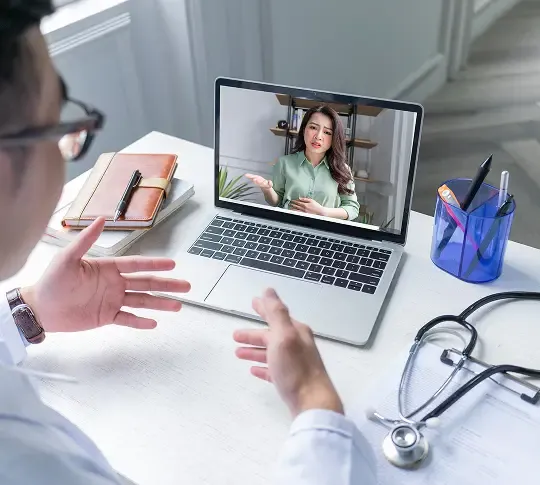
Photo: doctor verifying medical credentials on computer telehealth, via hcmsus.com
The promise of telehealth is compelling: consult a doctor from your living room, receive a diagnosis within minutes, and have a prescription sent to your local pharmacy before dinner. For millions of Americans managing chronic conditions, living in rural communities, or navigating crowded urban healthcare systems, virtual care has been genuinely transformative. But the same digital accessibility that makes telehealth so convenient has also opened a door that bad actors have been quick to walk through.
Unlicensed practitioners—individuals presenting themselves as physicians, nurse practitioners, or clinical specialists without holding valid credentials—have found fertile ground in the largely unregulated corners of digital health. The consequences for patients who unknowingly receive care from these individuals range from ineffective treatment to life-threatening harm.
The Scale of the Problem
The Federal Trade Commission and various state medical boards have issued repeated warnings about fraudulent healthcare providers operating online. In 2022 alone, the FTC received thousands of complaints related to deceptive health services marketed through social media, telehealth apps, and direct-to-consumer websites. Many of these complaints involved providers who either misrepresented their qualifications or operated entirely without licensure.
The problem is compounded by the fact that medical licensing in the United States is managed at the state level. A practitioner licensed in one state cannot legally provide care to a patient residing in another—unless they hold licensure in that second state as well. This jurisdictional complexity creates gaps that some unscrupulous operators deliberately exploit, claiming credentials that are either expired, invalid in the patient's state, or simply fabricated.
Red Flags Every Patient Should Recognize
Not every unlicensed provider announces their status. In fact, the most dangerous ones are skilled at projecting an air of clinical authority. However, several consistent warning signs tend to appear.
Vague or unverifiable credentials. A legitimate physician will hold a degree from an accredited medical school, have completed residency training, and carry a current license issued by a state medical board. If a provider's biography on a telehealth platform is vague—listing titles like "health consultant," "wellness advisor," or "clinical specialist" without specifying board certifications or licensing bodies—that ambiguity warrants scrutiny.
No physical address or licensing state listed. Licensed physicians in the US are required to hold state-specific licenses. Any telehealth provider who cannot clearly state the jurisdiction under which they are licensed should be treated with caution.
Prescriptions offered without a proper consultation. Legitimate telemedicine platforms require a synchronous consultation—either video or telephone—before any prescription is issued. Services that offer to send prescriptions based solely on a questionnaire, particularly for controlled substances, are operating outside standard medical practice and, in many cases, outside the law.
Pressure to avoid follow-up care. A licensed provider will typically encourage patients to maintain relationships with their primary care physicians and specialists. Providers who actively discourage follow-up care, second opinions, or pharmacy verification may be attempting to limit scrutiny of their recommendations.
Unusually low pricing with no insurance accepted. While direct-pay telemedicine is entirely legitimate, an extremely low fee structure combined with a refusal to interact with any insurance network can sometimes indicate an operation designed to fly under regulatory radar.
How to Verify a Provider's Credentials
The good news is that verifying a physician's license in the United States is a straightforward process—and it is one every patient has the right to undertake.
The Federation of State Medical Boards (FSMB) maintains a publicly accessible database called DocInfo, available at docinfo.org, which allows patients to search for any physician's license status across participating state boards. A search takes less than two minutes and can confirm whether a provider holds an active, valid license in the state where they are offering care.
For nurse practitioners and physician assistants, patients should consult the relevant state nursing board or physician assistant board, which maintain their own publicly searchable registries. Board certification in a medical specialty—issued by organizations such as the American Board of Internal Medicine or the American Board of Family Medicine—can be verified through the ABMS Certification Verification tool at abms.org.
Patients should also look for telehealth platforms that make provider credentials transparently accessible. At TrueMedo, every physician and licensed clinician connected through the platform undergoes rigorous credentialing verification before seeing a single patient. Credentials are not merely self-reported; they are independently confirmed against state licensing databases and professional certification registries.
Regulatory Gaps and What Is Being Done
The regulatory framework governing telehealth in the United States remains fragmented. During the COVID-19 public health emergency, many states relaxed interstate licensure requirements to expand access to care. While these temporary measures helped patients during an unprecedented crisis, they also created regulatory ambiguity that has been slow to fully resolve.
The Interstate Medical Licensure Compact (IMLC), which now includes the majority of US states, offers a streamlined pathway for physicians to obtain licensure in multiple states. However, participation is voluntary, and not all providers operating across state lines are doing so under legitimate compact arrangements.
State medical boards have increased their monitoring of telehealth complaints, and the Drug Enforcement Administration has tightened enforcement around online prescribing of controlled substances. Nevertheless, patients remain the first—and sometimes only—line of defense against encountering an unqualified provider.
Why the Stakes Are Higher Than They May Appear
It is tempting to assume that the worst outcome of consulting an unlicensed practitioner is simply receiving unhelpful advice. The reality is considerably more serious. An individual without medical training lacks the clinical knowledge to recognize contraindications, interpret symptom patterns that suggest a serious underlying condition, or understand how a recommended treatment interacts with a patient's existing medications.
Patients have reported receiving incorrect diagnoses for conditions that later required emergency intervention. Others have been prescribed medications at incorrect dosages, or have been given treatments that directly conflicted with drugs they were already taking for other conditions. In several documented cases, individuals posing as physicians have recommended patients discontinue prescribed medications—with dangerous results.
Demanding Better From Digital Healthcare
The expansion of telehealth represents a genuine advancement in American healthcare access. Rural patients, individuals with mobility limitations, working parents, and those navigating insurance barriers have all benefited from the ability to consult a licensed physician without leaving home. But access without accountability is not progress.
Patients deserve—and should actively demand—transparency from every digital health platform they use. That means knowing who is on the other side of the screen, confirming that their credentials are current and legitimate, and trusting that the platform itself has done the verification work on their behalf.
Real healthcare begins with real physicians. That is not a marketing claim. It is a clinical standard—and one that every patient engaging with telehealth has the right to hold every provider accountable to.