Caught in the System: How Diagnostic Delays Are Making Americans Sicker—And What Integrated Care Can Do About It
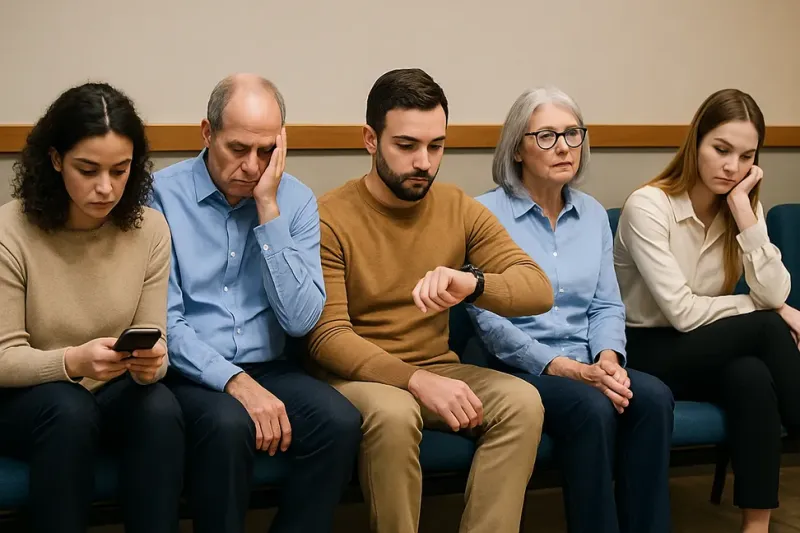
Photo: frustrated patient waiting in hospital waiting room looking at watch, via virtuaq.com
For many patients, the path to a correct diagnosis resembles a maze rather than a straight line. A persistent cough leads to an urgent care visit, which results in a referral to a pulmonologist, which requires prior authorization from an insurer, which takes two weeks to process—by which point the underlying condition has quietly advanced. This pattern, repeated across millions of American households every year, is not merely an inconvenience. It is a clinical crisis hiding in plain sight.
At TrueMedo, our network of licensed physicians encounters the consequences of delayed diagnosis regularly. The stories are varied in their details but consistent in their structure: a patient waited, the condition worsened, and a more aggressive—and expensive—treatment became necessary as a result.
The Anatomy of a Diagnostic Delay
Diagnostic delays rarely stem from a single failure. More often, they are the cumulative product of several overlapping bottlenecks, each one adding days or weeks to a patient's journey toward clarity.
Referral wait times represent one of the most significant obstacles. According to survey data from the American Medical Association, patients in major metropolitan areas often wait three to four weeks for an appointment with a specialist—and in rural regions, that figure can extend considerably further. A patient presenting with ambiguous neurological symptoms, for example, may wait over a month before seeing a neurologist, during which time they may visit two or three other providers who lack the subspecialty expertise to interpret their presentation accurately.
Insurance authorization delays compound the problem. Many diagnostic tests—MRIs, CT scans, certain blood panels—require prior authorization before an insurer will agree to cover them. This administrative process can take anywhere from 48 hours to several weeks, and denials requiring appeal extend the timeline further still. A physician may strongly suspect a particular diagnosis but be unable to confirm it until imaging clears the insurer's review process.
Diagnostic testing queues add yet another layer. Even after authorization is granted, patients may wait one to three weeks for a scheduled MRI or echocardiogram at a hospital-based imaging center. In high-demand markets, the backlog for certain specialized tests can stretch even longer.
The result is a patient who is symptomatic, anxious, and medically unresolved—sometimes for months.
When Waiting Becomes Dangerous: Real-World Consequences
Consider a scenario that TrueMedo physicians have encountered in various forms: a 52-year-old woman presents to her primary care physician with fatigue, mild shortness of breath, and occasional chest discomfort. Her physician, appropriately cautious, refers her to a cardiologist. The earliest available appointment is five weeks out. In the interim, she visits an urgent care clinic twice when her symptoms worsen; neither visit results in an ECG or troponin measurement because her presentation does not meet the threshold for emergency triage. She is given a diagnosis of anxiety and sent home. Three weeks later, she is hospitalized following a myocardial infarction.
This is not a hypothetical constructed for dramatic effect. Studies published in peer-reviewed journals, including research from the BMJ and JAMA Internal Medicine, have documented that delays in diagnosing conditions such as coronary artery disease, certain cancers, pulmonary embolism, and sepsis are directly associated with higher rates of morbidity and mortality. A 2023 study found that diagnostic errors—many of which are prolonged by systemic delays—contribute to approximately 40,000 to 80,000 deaths in the United States annually.
Cancer diagnoses represent a particularly sobering case. The difference between a Stage I and Stage III cancer diagnosis is often measured not in biological inevitability, but in the weeks lost to referral queues and authorization processes.
Why Fragmented Care Perpetuates the Problem
The American healthcare system, despite its technological sophistication, remains structurally fragmented. A patient's primary care physician, specialist, urgent care provider, and emergency room team frequently operate in separate electronic health record ecosystems that do not communicate with one another. Each new provider begins, in effect, from scratch—repeating questions, ordering duplicate tests, and potentially missing the connective tissue of a patient's full medical history.
This fragmentation creates a phenomenon physicians sometimes call the "diagnostic handoff problem." When a patient is referred from one provider to another, critical contextual information is often lost or diluted. A primary care physician's clinical intuition about a patient's trajectory—built over years of familiarity—rarely travels intact through a referral letter.
Urgent care clinics, while valuable for acute and low-acuity needs, are structurally designed for episodic care rather than longitudinal diagnostic reasoning. Emergency rooms, similarly, are optimized for stabilization rather than comprehensive workup. Patients who fall between these categories—sick enough to be concerned, but not acutely ill enough to trigger emergency protocols—are particularly vulnerable to diagnostic limbo.
How Integrated Telemedicine Compresses the Timeline
This is precisely the gap that integrated digital health platforms are positioned to address. When a patient connects with a licensed physician through TrueMedo, that consultation is not an isolated transaction. It occurs within a framework designed for continuity: documented medical history, coordinated follow-up, and direct access to physicians with the subspecialty knowledge relevant to a patient's specific symptom profile.
For patients whose symptoms suggest a condition requiring specialist evaluation, an integrated telemedicine platform can facilitate that connection within hours rather than weeks. A patient presenting with the symptom cluster associated with thyroid dysfunction, for example, can be evaluated by a physician with endocrinology expertise on the same day—rather than waiting for a referral appointment that may be weeks away.
Moreover, telemedicine physicians operating within an integrated system have access to a patient's prior consultation notes, enabling the kind of longitudinal clinical reasoning that is often absent in fragmented care settings. The diagnostic picture that emerges from a series of connected consultations is fundamentally richer than anything a single urgent care visit can provide.
It is important to state clearly: telemedicine is not a replacement for in-person evaluation in all circumstances. Certain presentations require physical examination, hands-on assessment, or immediate emergency intervention that no digital platform can replicate. TrueMedo's physicians are trained to recognize these situations and direct patients to appropriate in-person care without delay. The goal is not to substitute for the healthcare system, but to help patients navigate it more efficiently—reaching the right level of care faster, with better-informed clinical guidance at every step.
What Patients Can Do Right Now
While systemic reform of diagnostic delays requires policy-level change, individual patients are not entirely without agency. Several practical steps can reduce personal risk:
- Document symptoms meticulously. A written log of symptom onset, progression, frequency, and associated factors gives any physician—virtual or in-person—a more complete clinical picture in less time.
- Request copies of all test results and referral notes. Do not rely on providers to communicate with one another. Carry your records.
- Ask explicitly about timeline expectations. If a referral is placed, ask your physician what symptoms should prompt you to seek more urgent care before that appointment.
- Explore integrated care options for initial evaluation. Connecting with a licensed physician through a platform like TrueMedo can help clarify whether your symptom pattern warrants urgent escalation or can be safely managed while awaiting specialist availability.
- Advocate for expedited authorization when medically appropriate. Physicians can request peer-to-peer reviews with insurance medical directors to accelerate authorization decisions. Ask your provider whether this option is available.
The Cost of Time
In medicine, time is rarely neutral. For most conditions, earlier diagnosis correlates directly with better outcomes, lower treatment costs, and a higher probability of full recovery. The weeks spent navigating referral queues and insurance processes are not administrative inconveniences—they are clinical time with real biological consequences.
The American healthcare system contains extraordinary expertise. The challenge is not the absence of capable physicians; it is the structural friction that prevents patients from reaching the right physician at the right time. Addressing that friction—through integrated platforms, coordinated care models, and smarter use of telemedicine—is among the most consequential improvements the system can make.
At TrueMedo, that mission is not abstract. It is the reason our physicians show up every day: to ensure that the distance between a patient and an accurate diagnosis is measured in hours, not weeks.